          |
 When
a foundry was added to Holwell works it meant that the pig iron produced
by the blast furnaces could be turned into products on site.

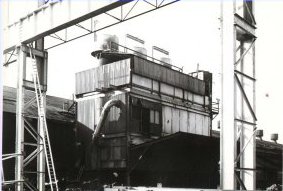
Above:
Three cupolas in use in the 1960s.
Left:
The lining of a cupola.
Cupolas are a
type of furnace used in a foundry to melt pig iron ready for casting.
 |
We had three
sets of cupolas, one little set where we melted iron everyday. The
working of the cupola was that you used it one day, and you repaired
it the next day whilst its companion was being used. We had three
departments and I think we melted at that time something in the
order of 100 to 150 tonnes of metal a day. This was consistent in
those days of something like 40% of pig iron and 60% of cast iron
scrap.
(Jack Smith)
|
|
Now the raw
materials were charged into the furnace, and melted and were tapped
out of a hole at the bottom of the furnace. It ran along a trough
which was called a launder, into the ladle. These ladles varied
in size from I would say from a couple of hundred weight up to 7
tonnes depending on which type of castings you were producing. And
then they were transported, the larger castings, the iron that was
produced for the larger castings,
was transported to the various moulding shops by a locomotive.
(Mervyn Hammond)
|
Ladles were
used to transport the molten iron from the furnaces to the moulding shops.
|
Now a ladle
might be anything that might carry sort of a gallon up to, we had
some ladles which carried ten tonnes of iron. This ladle of iron
was taken by rail, on runners and towed by a steam engine and taken
into the department where the moulds were waiting to be filled.
They weretaken by crane and then a man would turn the wheel which
cast it into the moulds that we had got. So that varied, some of
the ladles that we poured into in the small departments were so
small that one man would carry it around on another occasion you
would need a crane to carry a ten tonne ladle.
(Jack Smith)
|
|