Women in the War
Margaret Slater (née Towle)
2100873 TOWLE M.F - Radar Operator 1944-1947

|
Women in the War Margaret Slater (née Towle) 2100873 TOWLE M.F - Radar Operator 1944-1947
|
||
|
|||
        
|
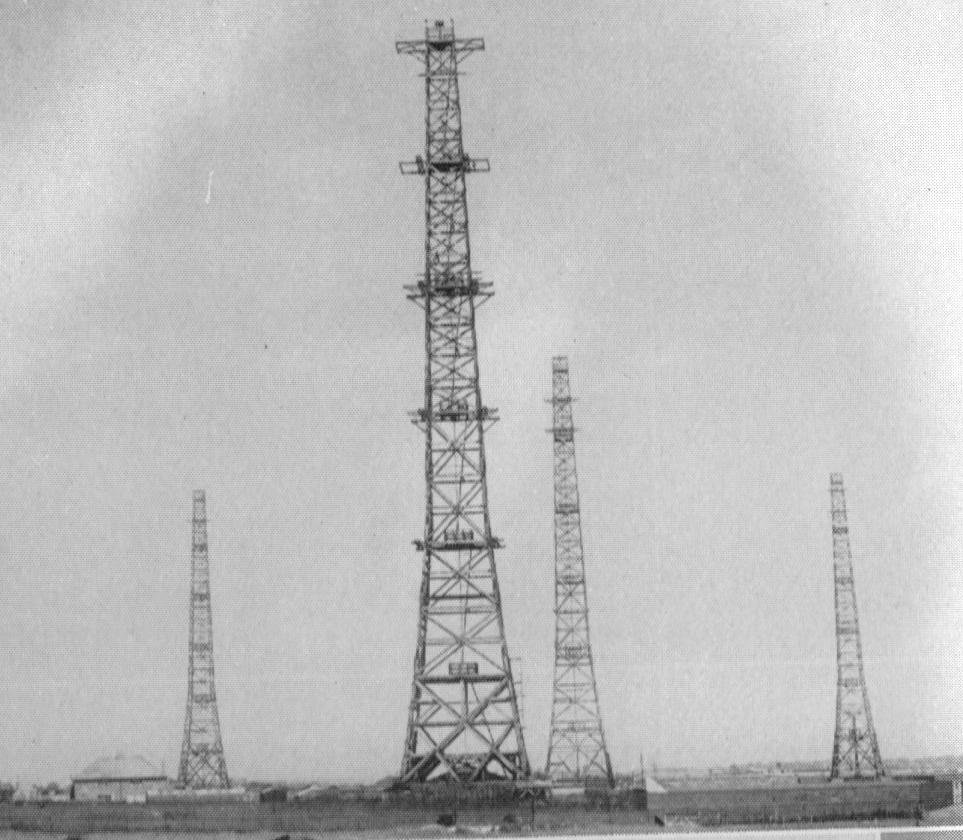
A CHL - Chain Home Low - mast (left) these would have been erected at the Dunnet Head Station to detect lower flying aircraft, and a CH - Chain Home - mast (right) these were used at stations all around the coast to detect higher flying aircraft. For more information on radar research and CH / CHL Stations please visit the Radar Research pages on this website Once in three weeks we could get into Thurso when our day off co-incided with the weekly liberty run. However there was not very much to do in the town: a few small shops, one hotel where we occasionally treated ourselves to a meal, a WVS canteen which we supported more frequently, one cinema and a variety of pubs. For the rest of the time when we were not on watch, on general morning fatigues, attending lectures or studying for a Trade Test, we would entertain ourselves in various ways. We often went for long walks on the cliffs (one could not get down to the sea); we played table tennis - even snooker if the men trusted us not to tear the baize with our cues; in the summer we bathed in the small lochans on the headland. A favourite occpation with some of us was to visit some of the crofts where we could always buy fresh eggs. It appeared that the area was too remote for the crofters to worry too much about Ministry of Food regulations which ruled that all eggs should be sent in to the nearest depot for official distribution. The crofters would always make us welcome offering us tea and a friendly chat by their peat fires; no doubt they in-turn would charge us for half-a-dozen eggs. Back at camp the Corporal i/c Cookhouse would cook them for us to add to our evening meal, or we would have a fry-up in the Ops Room kitchen when we were on night watch. In the evenings when we were not on watch we would spend hours dancing to records in the Rec Room as there was no NAAFI on camp. A few hundred yards from camp was Dunnet Head lighthouse, and a week or so after the war ended we learned that the lighthouse keeper would be pleased to show people over the lighthouse. So one afternoon half-a-dozen of us called at the keeper's house to ask if we might be shown around. Instead of the friendly welcome we had expected we got an extremely frosty reception as he pointed out in no uncertain terms that it was the Sabbath, a day on which no decent God-fearing person would have ever dreamed of making such a frivolous request. After being torn off such an almighty strip none of us ever ventured to call upon him again. The gales in the far north have to be experienced to be believed. The narrow pathways from the domestic site up to the Ops Blocks were roped on either side to prevent us from being blown over. On the one road in camp that was used by motor vehicles, where it was impracticle to have ropes to hold onto, there were several accidents of people being blown several yards onto the 9ft fence encircling the camp and breaking wrists and ankles. On another occasion in a severe gale the outer layer of the roof of the nissen hut in which 12 of us slept was ripped off. In the winter it was so cold that we were issued with six blankets rather than the statutory five. Most of these we doubled and then topped the lot with our green coats. Most of the accomodation was in the usual Air Ministry wooden huts which were centrally heated. However the nissen hut, home to twleve WAAF Radar Operators was heated by two stoves both of which were kept going permanently day and night throughout the winter. When going on leave we travelled on the train known as 'The Jellicoe' which ran from Thurso to London Euston. It was named after Admiral Jellicoe of the First World War and was for Service men and women only. It left Thurso at 1800 or 1830 and the men and women were strictly segregated. Depending on the number of women travelling, whether one or two coaches were reserved for them. An evening meal was served in the dining car and then the women were shepherded back to their carriages by the Officer OC Train. The coaches were then locked so that there was no access to or from the rest of the train, and several times during the night the Officer OC would come through to make sure that none of the men had gained access. At about seven-thirty in the morning the girls were 'let out' for breakfast in the dining-car and from then on the segregation was not quite so strict, although this depended to some extent on OC Train, and at which of the main line stations he was leaving the train. On our leaves from Dunnet Head we were given an additional 48 hours Travelling Time, and even though my home was in the north of England it took all of 24 hours to get from Thurso to Blackburn. We may not have known anything much about events leading up to VE Day but a day or two later we saw an unforgettable sight: six U-boats that had surrended in the Atlantic, being escorted through the Pentland Firth in to Scapa Flow by two Royal Navy destroyers. After six years of war this, to us, was more exciting than all the celebrations we heard about in the cities and towns. Click here to read on about Margaret's life in the WAAF after VE Day
|
||