Radar Recollections - A Bournemouth University / CHiDE & HLF project


Work at Bawdsey Manor - Part 2

 
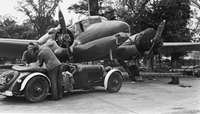
An AVRO Anson
An Aurd Anson
 
The next major problem that needed to be overcome was the sheer bulk of the transmitter equipment. The ability to build transmission and detection equipment that could fit into an aircraft was a high priority. Sir Henry Tizard had pointed out that whilst the CH system gave the much needed early warning, it did not give the fighter pilots sufficiently precise data to home onto their targets. He had already persuaded the RAF to begin experimental work at Biggin Hill concerning fighter interception techniques and possible methods of controlling their tactical movements from the ground.

Taffy Bowen 1911-1991
 

The difficulties of fighter interception were especially acute at night and in poor weather. He urged the development of homing equipment that could fit into the cockpit of a fighter plane. The idea was that 'ground controllers' could vector the plane to the general location of the enemy planes and then the pilot's own onboard radar could be employed for the final 'lock on'.

In September 1936,'Taffy' Bowen was set the task of solving this problem. Bowen had been already been experimenting with shorter wavelengths. He began with 6.7 metres but this still required an uncomfortably long half-wave dipole (initially slung between the wheels of a Heyford bomber!) aerial. The detection range was a respectable 8-10 miles. At this point, the receiver was in the aircraft but the (much larger and power hungry) transmitter was still on the ground.


This system was known as RDF1.5 because it was half way between a ground system (RDF 1) and a complete airborne system (yet to be devised) but coded as RDF 2. Bowen was more convinced of the value of RDF1.5 than Watson Watt was.

Higher frequencies were explored and by the late summer of 1937 it was possible to equip an Avro Anson with a 1.25 metre transmission and receiver set. The Anson was chosen because it was already in use by Coastal Command and the desire to detect ships as well as aircraft was now seen as essential.

By the Autumn the new aircraft was equipped with aircraft interception (AI) and the offshoot, air to surface vessel (ASV) equipment and the scientists had settled on a wavelength of 1.5 M.

NEXT STORY
CONTENTS PAGE
HOME PAGE
 
 
Mr
J. A. D. Cotton